
Are you studying GENKI Lesson 3 and finding Japanese verbs or particles difficult?
In Lesson 3, you begin learning how to talk about everyday activities, places, times, and invitations. These are essential skills for having simple conversations in Japanese.
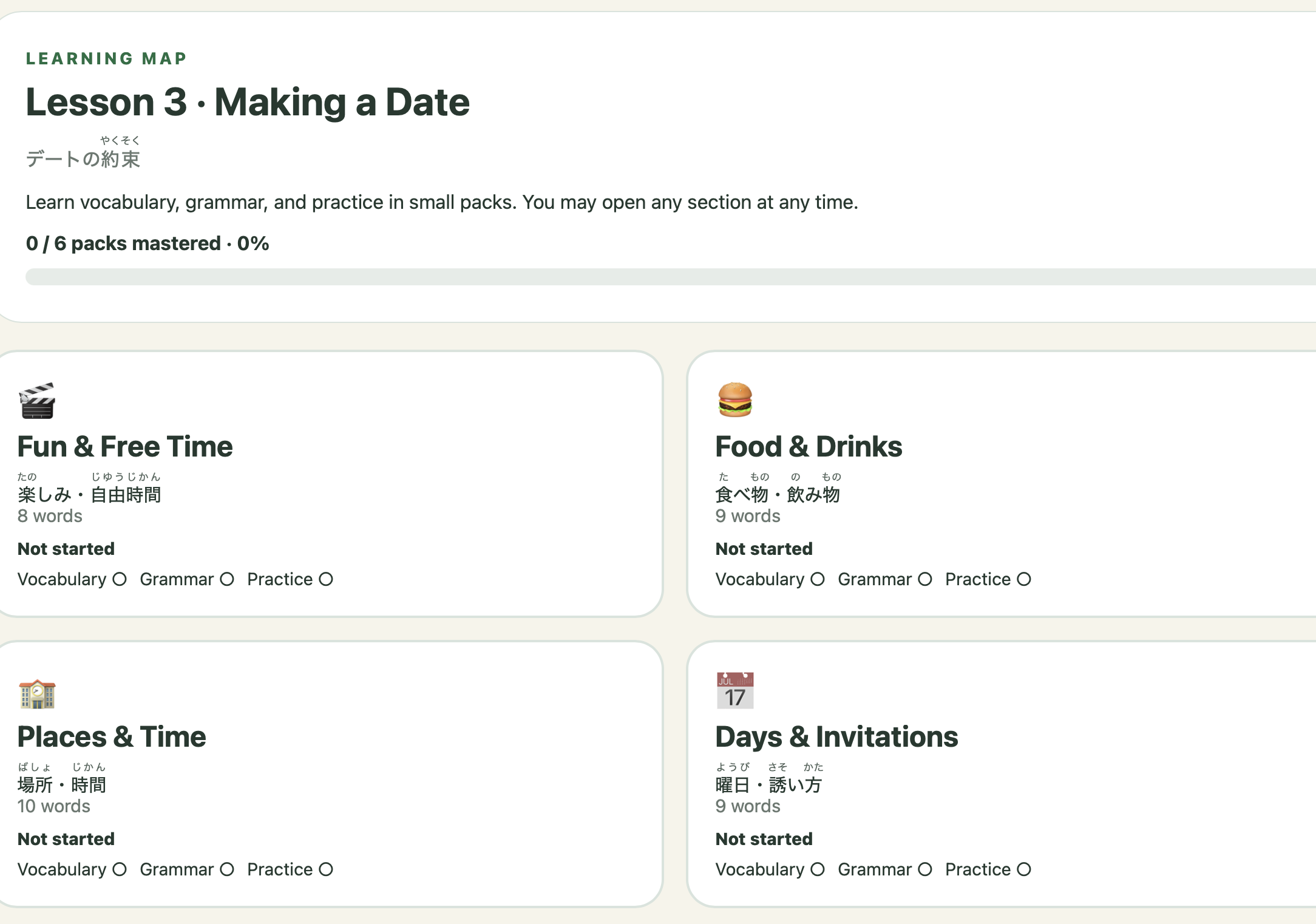
To help beginners review the lesson step by step, I created a free Japanese self-study app for GENKI Lesson 3.
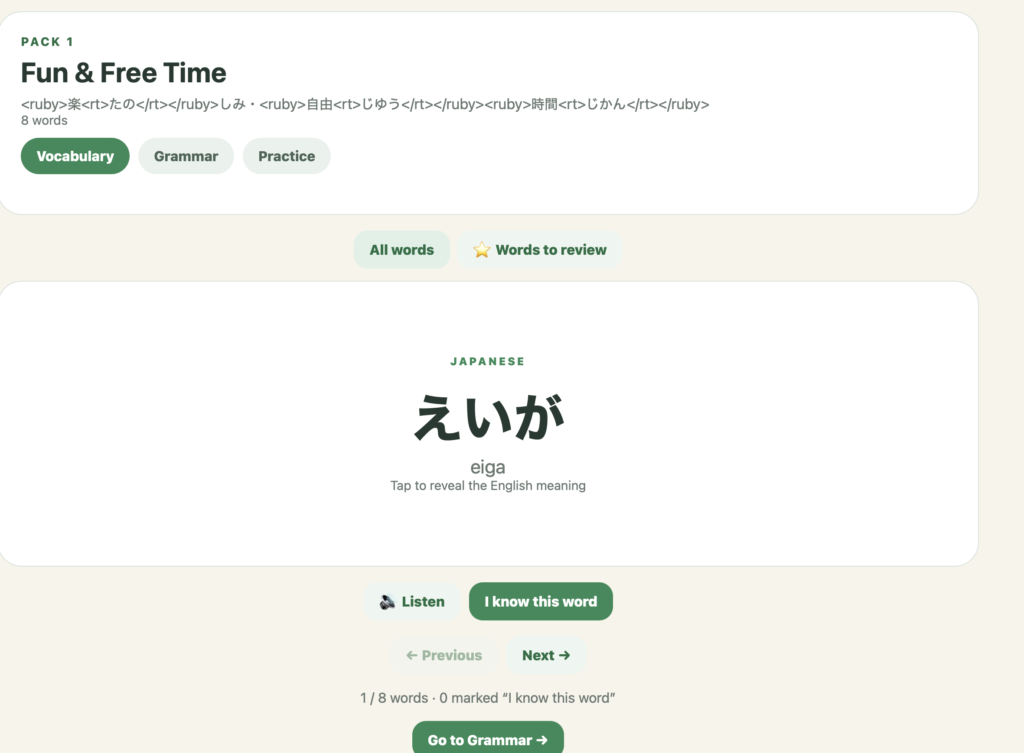
With this app, you can study vocabulary, review basic grammar, listen to Japanese words, and answer practice questions at your own pace.
- What Can You Learn in GENKI Lesson 3?
- 1. Learn Basic Japanese Verbs
- Start the Free GENKI Lesson 3 Practice
- 2. Understand the Particle を
- 3. Use で to Say Where an Activity Happens
- 4. Talk About Time
- 5. Make Negative Sentences
- 6. Invite Someone with ~ませんか
- A Teacher’s Tip for Learning Japanese Particles
- Common Mistakes to Avoid
- Try This Mini Quiz
- About the Free GENKI Lesson 3 App
- Review the Previous Lessons
- Final Practice
- Important Notice
- About the Author
What Can You Learn in GENKI Lesson 3?
The main theme of GENKI Lesson 3 is Making a Date(デートの約束).
In this lesson, you will learn how to:
- Talk about everyday activities
- Say where an activity takes place
- Talk about when you do something
- Make negative sentences
- Invite someone to do something
- Understand basic Japanese verb groups
- Use important particles such as を, で, に, and へ
These expressions are useful not only for studying Japanese but also for communicating in everyday life in Japan.
1. Learn Basic Japanese Verbs
Japanese verbs often come at the end of a sentence.
Here are some common examples:
- たべます (tabemasu) — to eat
- のみます (nomimasu) — to drink
- みます (mimasu) — to see or watch
- よみます (yomimasu) — to read
- ききます (kikimasu) — to listen
- いきます (ikimasu) — to go
- かえります (kaerimasu) — to return
- べんきょうします (benkyou shimasu) — to study
For example:
わたしは ほんを よみます。
Watashi wa hon o yomimasu.
I read a book.
わたしは にほんごを べんきょうします。
Watashi wa nihongo o benkyou shimasu.
I study Japanese.
When you learn a new verb, it is helpful to learn it as part of a complete sentence rather than memor the word by itself.
Start the Free GENKI Lesson 3 Practice
Use the free app below to practise the vocabulary and grammar from this lesson.
Open the Free GENKI Lesson 3 Practice App
2. Understand the Particle を
The particle を (o) marks the direct object of an action.
The basic pattern is:
Person は Object を Verb
Examples:
パンを たべます。
Pan o tabemasu.
I eat bread.
おちゃを のみます。
Ocha o nomimasu.
I drink tea.
えいがを みます。
Eiga o mimasu.
I watch a movie.
Although を is sometimes written as “wo” in romaji, it is usually pronounced “o” when it is used as a particle.
3. Use で to Say Where an Activity Happens
The particle で (de) shows the place where an action happens.
Examples:
うちで べんきょうします。
Uchi de benkyou shimasu.
I study at home.
としょかんで ほんを よみます。
Toshokan de hon o yomimasu.
I read a book at the library.
きょうかいで さんびかを うたいます。
Kyoukai de sanbika o utaimasu.
I sing worship songs at church.
Remember this difference:
- に / へ indicates the destination of movement.
- で indicates the place where an activity happens.
Compare these two sentences:
きょうかいに いきます。
Kyoukai ni ikimasu.
I go to church.
きょうかいで いのります。
Kyoukai de inorimasu.
I pray at church.
The place is the same, but the particle changes because the function of the place is different.
4. Talk About Time
The particle に (ni) is often used after a specific time.
Examples:
しちじに おきます。
Shichiji ni okimasu.
I get up at seven.
くじに べんきょうします。
Kuji ni benkyou shimasu.
I study at nine.
However, words such as きょう (today), あした (tomorrow), and まいにち (every day) usually do not need に.
きょう べんきょうします。
Kyou benkyou shimasu.
I will study today.
まいにち ほんを よみます。
Mainichi hon o yomimasu.
I read a book every day.
Try to learn time expressions as part of a complete sentence. This will help you remember when に is needed.
5. Make Negative Sentences
To say that you do not do something, change ます to ません.
Examples:
- たべます → たべません
- のみます → のみません
- みます → みません
- いきます → いきません
Example sentences:
コーヒーを のみません。
Koohii o nomimasen.
I do not drink coffee.
きょう がっこうに いきません。
Kyou gakkou ni ikimasen.
I will not go to school today.
In Japanese, the same verb form can describe a regular activity or a future activity. The intended meaning usually becomes clear from the context or time expression.
6. Invite Someone with ~ませんか
You can use ~ませんか to invite someone politely.
It may look like a negative question, but its natural meaning is:
“Would you like to…?”
Examples:
いっしょに えいがを みませんか。
Issho ni eiga o mimasen ka.
Would you like to watch a movie together?
いっしょに にほんごを べんきょうしませんか。
Issho ni nihongo o benkyou shimasen ka.
Would you like to study Japanese together?
A common positive response is:
いいですね。
Ii desu ne.
That sounds good.
You can also say:
はい、ぜひ。
Hai, zehi.
Yes, I’d love to.
A Teacher’s Tip for Learning Japanese Particles
As a Japanese language teacher, I have noticed that many students find it difficult to choose the correct particle, such as を, に, or で.
This difficulty does not always disappear as their Japanese improves. Even students at higher levels sometimes hesitate or choose the wrong particle.
Instead of memorising each particle by itself, try learning it as part of a short sentence.
For example:
- ほんを よみます。
Hon o yomimasu.
I read a book. - がっこうに いきます。
Gakkou ni ikimasu.
I go to school. - としょかんで べんきょうします。
Toshokan de benkyou shimasu.
I study at the library.
Reading and listening to these short sentences repeatedly can help you understand how Japanese particles are naturally used.
Common Mistakes to Avoid
Here are three mistakes that Japanese beginners often make.
Mistake 1: Forgetting the Particle を
Incorrect:
パン たべます。
Better:
パンを たべます。
In casual conversations, Japanese speakers sometimes omit particles. However, beginners should practise complete sentences first.
Mistake 2: Confusing に and で
がっこうに いきます。
Gakkou ni ikimasu.
I go to school.
がっこうで べんきょうします。
Gakkou de benkyou shimasu.
I study at school.
Use に for a destination and で for the place where an activity happens.
Mistake 3: Putting the Verb in the Middle
In English, we say:
I read a book.
In Japanese, we say:
わたしは ほんを よみます。
Watashi wa hon o yomimasu.
The Japanese verb normally comes at the end of the sentence.
Try This Mini Quiz
Choose the correct particle.
Question 1
わたしは ほん( )よみます。
A. を
B. に
C. で
Question 2
としょかん( )べんきょうします。
A. を
B. で
C. へ
Question 3
はちじ( )おきます。
A. に
B. を
C. で
Question 4
あした がっこう( )いきます。
A. を
B. で
C. に
Answers
- A — を
- B — で
- A — に
- C — に
If these particles are still difficult, don’t worry. Reviewing short sentences repeatedly will help you understand how they are used.
About the Free GENKI Lesson 3 App
I created this app for beginners who want to review Lesson 3 in small, manageable steps.
The app includes:
- Vocabulary flashcards
- English meanings
- Japanese audio
- Simple grammar explanations
- Practice questions
- Progress tracking
- A review-again function
- Vocabulary, Grammar, and Practice sections
Your progress is saved on your device, so you can stop and continue studying later.
You do not need to finish everything in one day. For example, you can study one section each day:
Day 1: Vocabulary
Day 2: Grammar
Day 3: Practice and review
Consistent practice is more important than trying to learn everything at once.
Review the Previous Lessons
If you would like to review from the beginning, you can also use:
- GENKI Lesson 1 Practice
- GENKI Lesson 2 Practice
Learning Japanese takes time, so it is completely fine to return to earlier lessons whenever you need to.
Final Practice
Try writing three sentences about your daily life.
- What do you do?
- Where do you do it?
- When do you do it?
For example:
まいあさ うちで にほんごを べんきょうします。
Maiasa uchi de nihongo o benkyou shimasu.
I study Japanese at home every morning.
You can also try inviting someone to do something with you:
いっしょに コーヒーを のみませんか。
Issho ni koohii o nomimasen ka.
Would you like to drink coffee together?
Small and regular practice will gradually help you understand and use Japanese more confidently.
I hope this free app supports your Japanese learning journey!
Important Notice
This is an independently created supplementary learning resource and is not an official GENKI app.
GENKI is published by The Japan Times Publishing. This app does not reproduce textbook pages, illustrations, or official exercises. Please use it together with your textbook.
About the Author
My name is Akiko. I am a registered Japanese language teacher and an occupational therapist living in Kobe, Japan.
I create beginner-friendly learning resources for everyday Japanese, travel, healthcare, and Christian life in Japan.

コメント